Google AI Overviews visibility: a practical guide
Build visibility in Google's AI Overviews and AI Mode in seven practical steps, from indexing to measurement, with a checklist for the next 90 days.
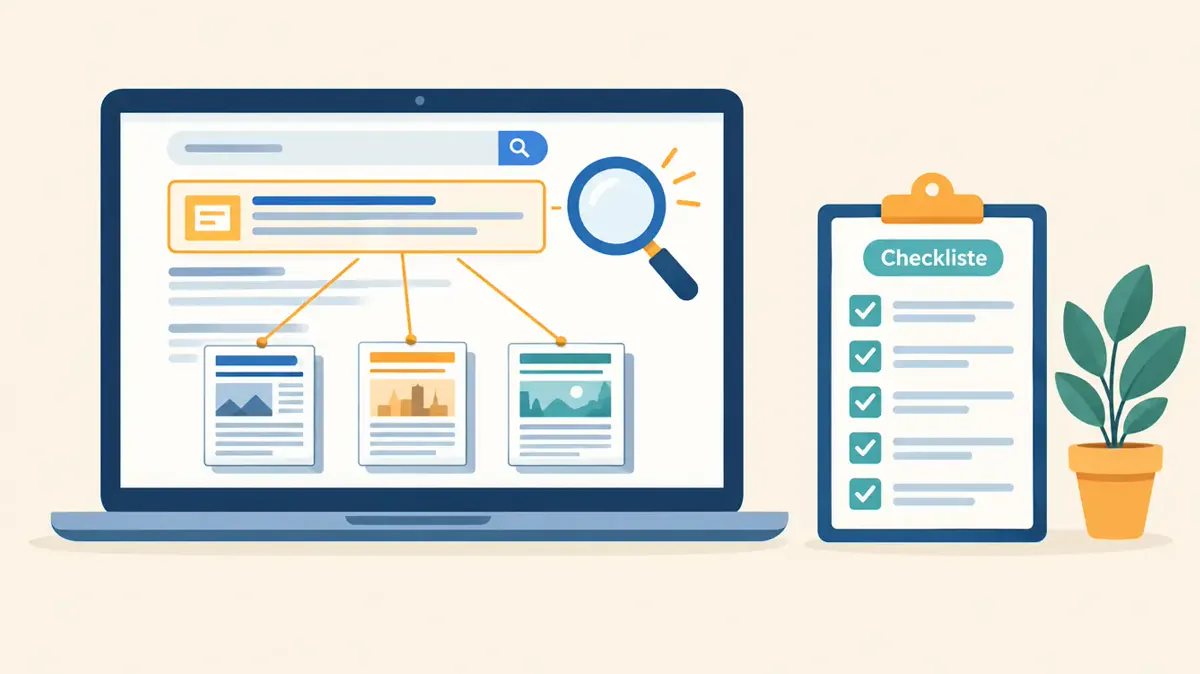 This image was generated entirely with AI
ProviderHiggsfield
ModelGPT Image 2.5
PromptFlat vector illustration, 16:9 landscape. A large laptop screen shows a search results page with one highlighted answer card at the top, linked by thin lines to three small newspaper pages and a magnifying glass floating beside it. On the right side, a clipboard with a checklist of five ticked items stands next to a small potted plant. Clean geometric shapes, soft blue, teal and warm orange palette, light beige background, subtle shadows, generous negative space. A small label on the clipboard reads "Checkliste". No real brand logos, no faces, no close-up hands. No watermark, no signature.
Want to appear as a source in Google's AI Overviews and AI Mode? It comes down to seven tasks: indexing, topic clusters, citable content, your brand as an entity, mentions, maintenance and measurement. This guide takes you through them in that order.
No placement is guaranteed. Google states publicly that the same SEO fundamentals apply to AI features as to classic search. A page must be indexed and eligible to show snippets. Everything beyond that comes from practical experience, and we label it as such.
If the terms are still new to you, start with what GAIO is and why mentions are the lever. This article focuses on putting it into practice for Google.
Step 1: Secure indexing
If Google does not index a page, it cannot appear as a source in any answer. Check the basics first.
- Does Google Search Console report your key pages as indexed?
- Is robots.txt or a noindex tag blocking pages that should be visible?
- Is the main content in the HTML, and can it be read without complex reloading?
- Is a nosnippet tag preventing Google from showing text excerpts?
- Do the pages load quickly and work properly on mobile?
Fix any errors here before you spend money on mentions. Every mention you win has less effect if the target page has technical problems.
Step 2: Topic clusters instead of single pages
AI answers often combine questions with several sub-topics. In practice, domains with broad, connected topic coverage are cited more often than domains with a single keyword page.
Here is how to proceed:
- Choose one core topic that your brand should stand for.
- Create a main page that explains the topic in full.
- Add subpages for specific questions, comparisons and use cases.
- Link the main page and subpages to each other in a sensible way.
An online shop for outdoor equipment could, for example, own the topic “lightweight trekking”. That would include packing lists, materials, care instructions and beginner questions.
Step 3: Write content that can be cited
AI systems summarise content and link to sources. A text whose statements can be lifted out one by one works in your favour.
- Definitions first: Answer the question in one or two sentences directly under the heading.
- Headings as questions or clear topics: Readers and machines see immediately what a section covers.
- Lists and tables: Comparisons and steps are easier to grasp this way.
- Backed-up statements: Name the source, period and method when you use figures. Never invent data.
- Author details: Show who wrote the text and why they know the subject.
Test every paragraph with one simple question: would someone understand the sentence if they read it without the rest of the page? If so, it can be cited.
Step 4: Strengthen your brand as an entity and win mentions
An entity is a clearly identifiable thing, in this case your brand. The more consistently media and specialist sites name it in the right topic area, the easier it is to classify. This is an observation from practice, not a rule confirmed by Google.
Here is how to build it:
- Use the same brand name and the same short description everywhere.
- Keep company details on your website up to date, such as the legal notice, About page and author profiles.
- Win editorial mentions in media that fit your topic.
Not every mention counts equally. The article on editorial links and authority explains how editorial links differ from advertorials. This article on how AI search selects sources describes how AI search pre-selects sources.
A mention without a DoFollow link is also worth having. It strengthens the link between your brand and the topic and brings readers to your site. Whether a link is DoFollow, nofollow or sponsored is decided by the publisher according to its editorial guidelines. Paid placements must be recognisable as advertising. Google's spam policies require rel="sponsored" or rel="nofollow" for paid links. You will find the details in the overview of link attributes.
In the catalogue you can filter media by media type, format, niche and maximum price. For each domain you see metrics such as organic traffic, Domain Rank and spam score. Put topic fit ahead of high values. If you already have a press release or an article, the content assistant suggests suitable channels and explains why.
Step 5: Maintain and measure
Update your key pages regularly. Outdated figures, dead links and obsolete recommendations damage trust, with readers and with systems alike. In practice, well-maintained pages often appear more frequently in AI answers. This is not proven as a rule. Good maintenance helps the reader in any case.
You need several sources for measurement, because there is no single metric for AI visibility.
| Metric | What it shows | Where to find it |
|---|---|---|
| Impressions, clicks, rankings | Baseline visibility in search | Google Search Console |
| Brand searches | Growing awareness | Search Console, Google Trends |
| Referring domains and mentions | Authority in your topic area | SEO tool of your choice |
| Referral traffic | Visitors from mentions | Web analytics |
| Sample prompts | Citations in AI answers | Manual tests in Google, ChatGPT, Perplexity |
Define 10 to 20 questions that your target audience asks. Test them every month and note which sources are cited. AI answers vary, so the trend over several weeks matters, not a single result.
Checklist for the next 90 days
- Check indexing and snippet settings for your most important pages.
- Choose one core topic and plan the cluster of main page and subpages.
- Revise existing pages with a definition, a list or table, and clear source references.
- Standardise your brand name, short description and author profiles.
- Update the target page before mentions go live.
- Select a few suitable media and send a briefing with your message, brand and link request.
- Make sure paid placements are marked correctly as advertising.
- After four to six weeks, review rankings, referral traffic and sample prompts, and adjust.
Start with steps 1 and 3, because they cost no media budget. Book mentions only once your target page is ready. The article on your first booking in four steps shows how a briefing is structured.
Frequently asked questions
Can I sign up for AI Overviews or influence them directly?
No, there is no sign-up and no switch. Google states that the usual SEO fundamentals apply. You can improve indexing, content and authority, but you cannot force a placement.
Do I need DoFollow links for AI visibility?
A DoFollow link is helpful, but it is not the only form of value. Mentions with nofollow or sponsored can also support awareness, referral traffic and how your brand is classified within a topic. You must always label paid links.
How long does it take for measures to work?
That depends on the topic, the competition and your starting point. Allow several weeks to months and evaluate trends rather than single results. Promises of fixed results are not credible.
Is it enough to optimise content alone?
Often yes, to begin with, especially for niche topics with little competition. For competitive topics, mentions in credible media help as well, because they make your brand visible in its topic area.